
Why Grants Aren’t Enough: The Case for Catalytic Capital
The global social sector is at an inflection point. For decades, grants, particularly from bilateral donors and large foundations, have underwritten much of the world's social and environmental work. That model is now under strain as grant funding becomes scarcer and more restricted. The effective dismantling of USAID, combined with announced sunset timelines of major philanthropies such as the Gates Foundation, signals a structural shift rather than a temporary disruption.
At the same time, the scale and complexity of global challenges continue to grow, requiring the ecosystem to chart new paths to propel its vital work forward in a world of shrinking resources. The question facing mission-driven organizations is no longer simply how to raise more grant funding and then efficiently translate it into impact, but how to build models that can sustain impact over time without perpetual grant funding.

Impact Investing and Catalytic Capital: A Vital Distinction
Two concepts are increasingly central to this conversation: Impact Investing and its specialized subset, Catalytic Capital. While often used interchangeably, understanding the differences is critical for designing viable pathways forward.
Impact Investing refers to the broad class of investments made with the intention to generate measurable social and environmental impact alongside a financial return. Many impact investors target market-rate or near-market returns, thus investing in deals that are also attractive to mainstream socially-neutral investors.
Catalytic capital, by contrast, is a specialized form of impact investment defined by its willingness to accept disproportionate risk and/or concessionary returns to generate positive impact and enable third-party investments that otherwise would not be possible.
Catalytic capital operates in two distinct structures: Anchoring/Blending (Vertical) and Priming/Market Building (Horizontal). First, it can serve as a de-risking layer within blended finance structures, accepting subordinated positions or below-market returns to "crowd in" commercial investors who require market-rate returns. This vertical structure is focused on a specific deal and capital stack, creating a funding layer that reduces risk for the other investors. The second, horizontal, structure provides the first capital to novel social enterprises (or funds) to develop evidence of new models through patient equity, flexible debt, or even grant-like funding for ventures too early-stage or too risky for conventional impact investors. Rather than supporting specific deals, the horizontal structure builds up markets and creates evidence proving innovative business models. This is in some ways analogous to how venture capital backs high-risk startups, but optimizing for impact returns rather than financial multiples.
The distinction between impact investment and catalytic capital is driven by additionality—the contribution that would not have happened otherwise. Traditional impact investing often follows established paths, whereas catalytic capital is willing to venture where others will not, supporting early-stage models and serving as the bridge between pure philanthropy and commercial capital.
The NGO Reality: Caught Between Grants and Markets
Most NGOs today are facing an existential dilemma. Grant funding is no longer sufficient to sustain operations, yet fully commercial models often prove incompatible with mission, especially when serving low-income or vulnerable populations.
Consider agricultural extension services for smallholder farmers. Digital tools for soil testing, crop planning, or climate risk management can dramatically improve productivity and resilience. However, smallholders have limited resources, adoption time is lengthy, and margins are thin. Organizations targeting such populations will rarely be compatible with venture-scale high-growth models and funding requirements. At the same time, grant funding can distort incentives, constrain scale, and create dependency; the latter especially pernicious as grant availability dwindles. Social enterprises operating in this space increasingly require patient capital that allows them to build revenue streams gradually, experiment with pricing, and build long-term relationships. This is where catalytic capital, deployed as a horizontal evidence-building structure, can play a decisive role and allow us to rapidly develop and test new models.
New Models Require New Expectations
A class of social businesses has emerged over the past two decades that are neither traditional NGOs nor conventional for-profits. These entities generate revenue, but they are not designed for exits or exponential growth. Instead, they prioritize durability, local embeddedness, and long-term impact.
Yet this category must grow significantly faster than it has to date. The transition cannot occur organically over another twenty years, as the contraction of grant funding demands accelerated development of revenue-generating models. Catalytic capital is uniquely suited to enabling this transition. Unlike grants, which maintain an increasingly unsustainable status quo, and market-rate capital (including a substantial portion of impact investment), which lacks the appetite for social businesses, catalytic capital can underwrite organizational evolution: supporting the multi-year transition from grant dependence toward earned revenue and cost recovery while maintaining mission integrity.
Rethinking Roles Across the Ecosystem
These shifts demand a reconfiguration of roles across the social sector ecosystem.
NGOs must reimagine themselves as builders of durable institutions, not just implementers of time-bound projects. This requires building financial management capacity and embracing hybrid models that combine grants, concessionary capital, and commercial revenue.
Philanthropy faces a fundamental choice: continue funding short-term outputs or invest in long-term systems change. Catalytic capital offers a mechanism to do the latter: enabling organizations to transition from perpetual fundraising toward financial sustainability while maintaining mission lock through governance structures and legal accountability mechanisms.
Grants will remain vital in special circumstances where self-sustaining business models are not feasible. Similarly, the broader class of impact investment is obviously valuable to sustain social businesses that have reached market maturity. Catalytic capital, however, is uniquely crucial in the current moment of transition as well as, in the long term, for enabling new entrants to prove themselves and reach financial sustainability and crowding in additional funders and capital to the social sector.
Additional players have roles to play as well. Governments and development finance institutions can act as market shapers by creating policy frameworks and guarantee mechanisms that legitimize catalytic models and reduce perceived risk for follow-on investors. Corporates can contribute by engaging as long-term partners in shared-value models rather than merely funding short-term pilots and projects.
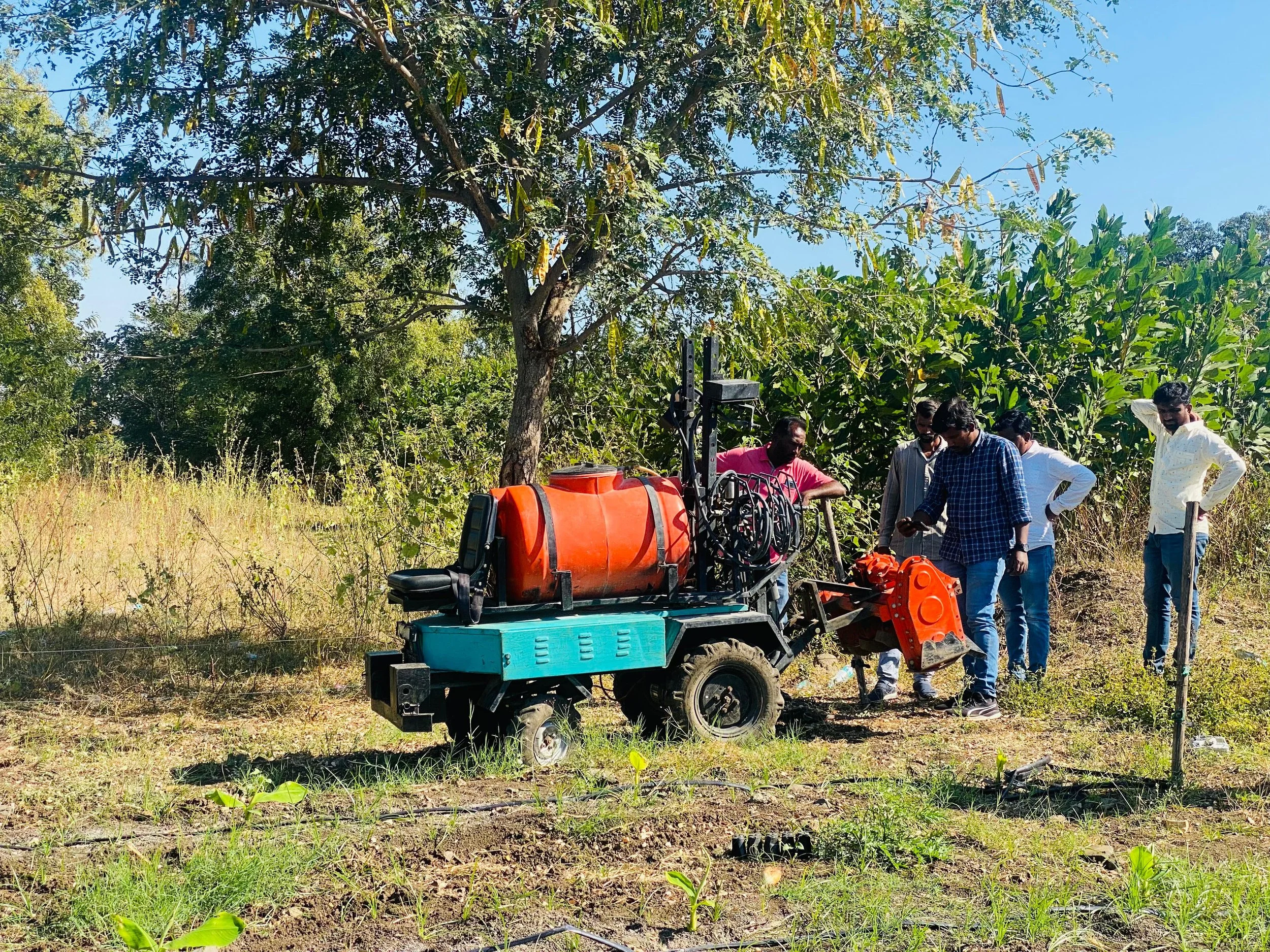
Feild visit with solution partner Farm Sathi, a fully electric remote-controlled robot advancing accessible machization for smallholders.
From Funding Survival to Impact Durability
The social sector is being forced to change whether it is ready or not. The erosion of traditional grant funding exposes not only a financing gap, but a design flaw in how impact has been funded for decades.
The challenge ahead is not simply to replace grants with new sources of capital, but to design organizations and financial structures fit for long-term, durable impact. Catalytic capital and impact investment, as well as the remaining available grant funding, can serve as the financial foundation for this shift, but only if deployed strategically to build organizational capacity, not merely to fund individual projects.
If we leverage this inflection point to transform our underlying models, the contraction of grant funding need not diminish the social sector, but rather can serve as the catalyst to rebuild one that is more effective, more resilient, and ultimately more capable of long-term impact.
About the Author

Daniela Kandel,
EIP Co-founder and CEO,
Before founding EIP, Daniela built her career at the intersection of innovation ecosystem development and development finance. Through her roles at Start-Up Nation Central and within the Israeli government, she worked across the full innovation lifecycle—from ideation to scale and measurable impact.